The actual link that the article refers to is a taken down website. hahaha. The below article demonstrates my attempt to explain "noncommutativity" without using the term - and so no one could understand me. hahahaha.
https://indigus.wordpress.com/2007/12/24/how-the-west-lost-alchemy/
Against Archytas: How the West Lost Alchemy or Paranormal Complimentary Opposite Harmonics
by drew hempel, MA
(anti-copyright, free distribution)
The
early Greek mathematics used the 60-based number system of Babylon from
which Archytas, a collaborator with Plato, received the harmonic
tetrachord or the continued proportion 6:8::9:12. This tetrachord
creates a geometric mean between the octave, perfect fourth and perfect
fifth music intervals, or 1:2:3:4, through “divide and average”
logarithmic-based mathematics. So 6:8 and 9:12 are in the continued
proportion 3:4, the perfect fourth music interval, while 6:9 and 8:12
are 2:3, the perfect fifth music interval, and 6:12 is 1:2, the octave.
The geometric mean is A:B::B:C or B squared = AC or the square root of
AC = B. What Archytas added to this Babylon “divide and average”
harmonic mathematics was the concept of the Greek “incommensurable” –
the algebraic axiomatic proof of “alogon” or a precise irrational
number, the square root of two. This process ushered in what’s called
“The Greek Miracle” that continues to be the structure of science:
symmetry-based mathematics.
Instead
of the above system, the alchemical Pythagorean Tetrad relies on
complimentary opposite harmonics so that an equilateral triangle of
geometric points equals the continued proportion 1:2:3:4 as the octave,
perfect fifth and perfect fourth music intervals. In “orthodox”
Pythagorean harmonics this was known as the “subcontrary mean” whereby
the complimentary opposites of the Tetrad were maintained in violation
of “divide and average” mathematics. So for the Tetrad A:B is 2:3 and
B:A is 3:4 against the commutative property, A x B = B x A. In music
theory this complimentary opposite inversion of the perfect fifth and
perfect fourth is taught as 2:3 is C to G while 3:4 is G to C. This
process of complimentary opposites is listened to, as the perfect fifth,
perfect fourth harmonics, which create all the notes. Most importantly
the complimentary opposite harmonics transduces sound throughout the
whole energy spectrum, as I’ve described in previous articles…
Philolaus, one of the early Pythagorean writers, detailed that this
“subcontrary mean” or complimentary opposite harmonic caused any attempt
at subdividing the scale into symmetry as a failure. In contrast
Archytas changed the “subcontrary” complimentary opposite mean into the
“harmonic mean” using “divide and average” mathematics. The outcome has
precisely opposite the meaning of “harmony” which for Pythagoreans
referred to the paranormal source of sound as the Goddess Harmonia or
what I call female formless awareness. For Philolaus the perfect fifth
as 2:3 could be inverted to 3:2 and then extended another fifth to 9:4
and then divided back into the octave, below 2, for the major second
interval of 9:8 or C to D. Yet 9:8 cubed or three major second music
intervals equaled the 3:2 perfect fifth music interval, plus a tiny
ratio called “the comma of Pythagoras.”
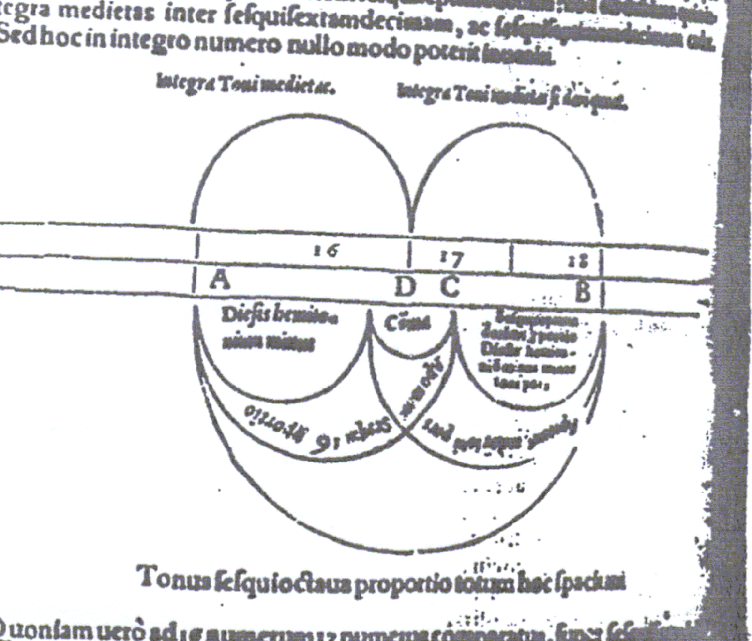
This “comma of Pythagoras” is the difference between the “divide and
average” octave system adopted by Archytas and the complimentary
opposite fifths inverting into fourths, used by the orthodox
Pythagoreans. The “comma of Pythagoras” is the key to harmonic alchemy
whereby 2:3, the perfect fifth, is yang in Taoism and 3:4, the perfect
fourth, is yin. As Gurdjieff desribes the “shock” of the diatonic
scale, whereby the “inverse ratios” do not line up with the octaves, is
intensified as the octaves expand. In contrast Archytas argued that 9/8
cubed or three major second intervals equals the square root of two as
the Greek Miracle, the axiomatic algebra of the precise incommensurable
irrational number. What Archtyas essentially did, as I’ll describe, is
equate the perfect 5th or 2:3 with the perfect 4th or 3:4 as
equally-divided or symmetric ratios through a “divide and average”
mathematics.
Archytas took the Babylonian geometric mean of 6:8::9:12 used for
harmonics and then applied the Pythagorean Tetrad 1:2:3:4 so that the
2:3 ratio of complimetary opposite frequency was converted to 3:2 as a
materialistic vibrating string length. This became known as the Law of
Pythagoras even though it goes against the true meaning of the
complimentary opposites when this “inverse ratio” is combined with the
“divide and average” commutative property. Gurdjieff, for example, still
relies on the “inverse ratio” of density or string length versus
frequency or consciousness. But Gurdjieff does not use Archytas’
“divide and average” symmetric-based mathematics, instead Gurdjieff
relies on the Law of Three aka the Tetrad, or octave-fifth-fourth, to
resonate through the comma of Pythagoras as the “shocks” of alchemy. In
Taoism this system of alchemical shocks is taught as the 12 harmonic
nodes along the outside of the body, enabling healing and paranormal
energy, an exercise called “the small universe.”