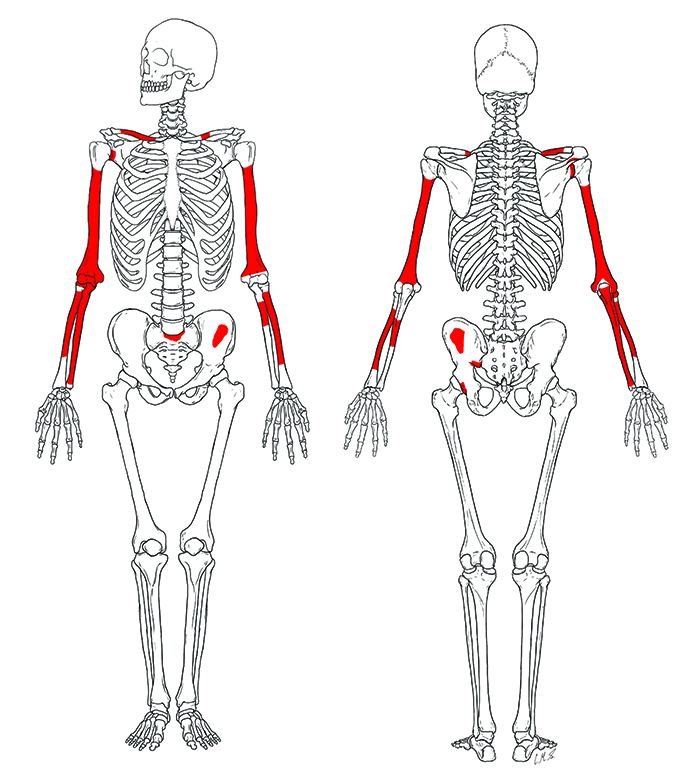
The new, exceptionally complete Homo habilis skeleton (specimen KNM-ER 64061) found in the Lake Turkana Basin of Kenya is dated to between 2.02 and 2.06 million years old. Discovered in the Koobi Fora Formation, this 2026-analyzed find provides the most complete postcranial remains of the species ever found, showing unexpectedly primitive, long arms https://www.sciencealert.com/this-2-million-year-old-fossil-may-be-the-oldest-example-of-an-early-human
So far, only two cranial sections with associated dental remains have been found for Homo erectus and three for Homo habilis. Recent compelling evidence suggests that both species co-existed in eastern Africa between 2.2 and 1.8 million years ago. Plus, several other hominin species probably lived at this time and in the same region: P. boisei and H. rudolfensis.
People complain about having to unfold the TG each time they use it. Much better to keep it set up with a 3.25" wide resistance band and cables extended with gym hoop straps. Just add more 3.25" bands to get that X-3 experience for "bent rows" and "biceps" and "chest presses" and "squats." TG with 3.25" wide bands (four as max, two on each side) for serious squats.
I just got a better ankle strap (Nealfit) since the TG foot strap is a pain in more ways than one. I think TG plus four 3.25" wide bands plus cable extensions is way underrated. Skyler points out that it's only "user error" if people think they can't get enough resistance on the TG.
So having the TG unfolded and set up - I just tuck into a closet and then easily pull it out with the band left on. It slides on one corner on the carpet.
People complain about being upside down on the TG but I think mimicking our millions of years living in the trees is a good thing. A "jungle gym for adults" is how someone called my TG. Civilization has existed for 10,000 years but science has proved we lived in trees part of time back 2 million years ago.

"2-million-year-old fossils, such as those from South Africa, show shoulder and hip structures suited for both arboreal, tree-swinging movement and terrestrial bipedalism....its arms and legs show it was far more comfortable swinging in the trees ...From a distance I’m not sure one would notice differences between sediba and human walking,... why was A. sediba, the most human-like of all australopiths, so well adapted to tree living? “This is the question we are struggling with right now,” says DeSilva.
AI says:It
stood about 1.2 meters (3.9 ft) tall. It possessed a human-like hand
and pelvis, suggesting bipedalism, but retained long arms and a small
brain, indicating it still frequented trees. Evolutionary Link: Initially, researchers suggested A. sediba was a direct ancestor of the Homo genus. However, subsequent studies and the earlier age of other Homo fossils have made this claim controversial, with some scientists arguing it is a sister species to A. africanus or a late-surviving, related species. Significance: It serves as a vital bridge in understanding the transition from ape-like australopithecines to the early Homo species, highlighting how mosaic evolution created diverse early human relatives.
we could not reject the hypothesis that A. sediba shares its closest phylogenetic affinities with the genus Homo. Therefore, based on currently available craniodental evidence, we conclude that A. sediba is plausibly the terminal end of a lineage that shared a common ancestor with the earliest representatives of Homo.
A. Sediba 2 million year old ancestor of Homo?
We report the presence of Homo at 2.78 and 2.59 million years ago and Australopithecus at 2.63 million years ago. Although the Australopithecus specimens cannot yet be identified to species level, their morphology differs from A. afarensis and Australopithecus garhi. These specimens suggest that Australopithecus and early Homo co-existed as two non-robust lineages in the Afar Region before 2.5 million years ago, and that the hominin fossil record is more diverse than previously known. Accordingly, there were as many as four hominin lineages living in eastern Africa between 3.0 and 2.5 million years ago: early Homo1, Paranthropus2, A. garhi3, and the newly discovered Ledi-Geraru Australopithecus.
3.4 million year old Hominin? vid
Australopithecus is a genus of early, bipedal hominins that lived in Africa approximately 4.18 to 2 million years ago. As direct ancestors or close relatives to the Homo genus, they are characterized by a mix of ape-like features (small brains, 400–500 cc) and human-like traits, such as bipedalism
An opposable big toe like a thumb - to grasp trees
https://www.youtube.com/watch?v=zIZSyPMoHIU
Australopithecus used and made stone tools just like Homo habilis....

No comments:
Post a Comment