Why the 4 stroke engine prevailed - vid
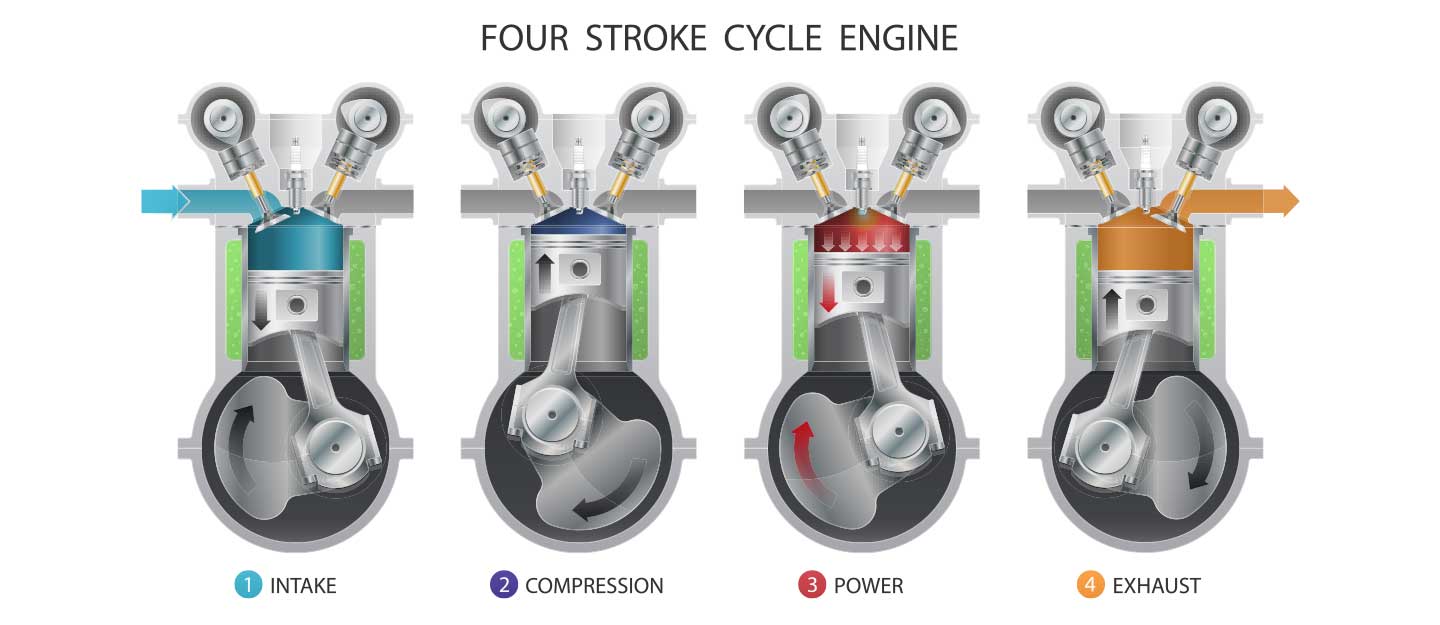
So the RPM is actually two crank rotations to complete the four strokes as
Intake (suck), compression (squeeze), power (bang) and exhaust (blow)
The first stroke, is a downward one, with the intake valve open, it sucks in fuel and air. This is called the intake stroke.
The second stroke happens from the bottom, to the top, the intake valve closes, and the piston moves up. This compresses the air and fuel mixture. At the top of this stroke, the spark plug fires.
The third stroke, is the power stroke, When the spark plug fires, the fuel and air burn making the pressures in the cylinder go up, and push the piston down forcefully. This is the power stroke.
At the start of the fourth stroke, the exhaust valves open, and the piston travels up, pushing the burnt fuel and air out the exhaust valve. At the end of the fourth stroke, the piston is once again at the top..
Ready to start the first stroke again.
Fuel BURNS beginning with a spark for ignition, it called “ deflagration” causing EXPANSION, applying force to the piston forcing it towards the cylinder bottom. If the engine RPM is 4000 it does this 2000 times per minute, in each cylinder of a four stroke engine.
During this time, the crank shaft went 2 full revolutions and the cam shaft(s) 1.
Each piston does this, on it's own, independent of the other pistons.
Harley Davidson for example uses a ‘big bang’ design. The two cylinders fire one after the other 45 degrees apart, then the engine effectively ‘coasts’ through 675 degrees. This gives Harley’s their distinctive sound. Because a big-bang engine has uneven power delivery, it tends to run rougher and generates more vibration than an even-firing engine.

No comments:
Post a Comment