From Cooperative Commonwealth to Yardstick Capitalism
I haven't been up north since last Fall - but there's a town downtown up north in Minnesota that has a statue in honor of the International Workers of the World - a radical mining and logging union. Did they work with farmers much? The IWW had a strong anarchist connection and now "anarchists" are still targeted by the Drumpf fascist regime - yet that area of Minnesota probably turned to supporting Drumpf?
His father and grandfather were proud miners — and staunch Democrats. It got to the point growing up, Vlaisavljevich said, where "a Republican was a scary thing."
But now, the 60-year-old is a vocal Trump supporter, with a Trump bumper sticker plastered on the front of his desk.... He believes Democrats are too beholden to environmental groups and have become less supportive of mining....Across the Rust Belt of the Upper Midwest, from Ohio to Wisconsin to the Iron Range, voters who sided with President Barack Obama in recent elections instead took their chances on Trump this year.
...most local and state DFLers easily won reelection.
So there is a bit of a schizoid approach as the unions stayed democrat and local politics stayed democrat but on the national level people voted Drumpf...against Hillary Clinton....
Since 1900, Minnesota has voted Democratic 65.6% of the time
he did capitalize on the economic discontent of the 1930s to champion the idea of a cooperative society distinct not only from socialist and communist economic systems but also from corporate capitalism.
Midland Cooperative Wholesale, a farmer- owned federation that sold gasoline and automotive supplies wholesale to cooperative oil associations, sprang up in the Midwest
during America’s farm recession in the 1920s. Struggling with skyrocketing production costs, farmers organized to purchase their supplies collectively.
Midland federation included hundreds of cooperatives throughout the Midwest that had
joined Midland to challenge the primacy of corporations. In addition to cheap gasoline and related products that farmers needed, Midland offered its members a cooperative way of life that strove to build a society based on good will.
By the time it peaked in the 1970s, prior to its 1982 merger with Land O’ Lakes (another
cooperative), Midland was one of the largest farm- supply cooperatives in the United States. It claimed 300,000 members among its federation of more than 700 cooperatives.
Land O'Lakes is technically a cooperative still but is it really?
Her first job was detasseling corn for $2 an hour. During college, she cleaned toilets and painted houses.
Decades later, after working in a number of leadership positions at companies such as Mobil (now owned by Exxon), PepsiCo and Scholastic, Ford joined Land O’Lakes in 2012, where she would climb the corporate ladder to the C-suite.
Her appointment to CEO in 2018 wasn’t just a personal achievement, it was a historic milestone: Ford is the first woman to lead Land O’Lakes in its 101-year history, and the first openly gay woman to become a Fortune 500 CEO.
There are currently 44 women CEOs who run Fortune 500 companies, a record high.
https://familyfarmers.org/?p=784
Family Farm Defenders is an activist group that has campaigned against Land O'Lakes, criticizing the large dairy cooperative for promoting industrial agriculture, driving down milk prices for small producers, and supporting factory farm expansion
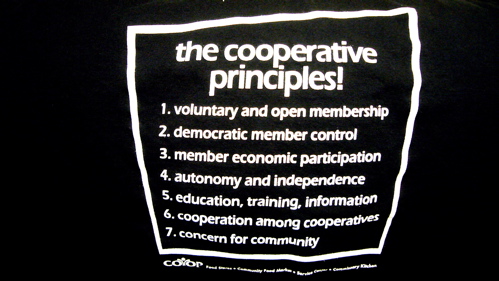
Given that 2012 is the U.N. Year of the Co-op, it is also disturbing to have a once proud farmer driven co-op like Land O Lakes routinely violating the Rochdale Principles of International Cooperation, as well as the 1922 Capper Volstead Act.
Land O Lakes in the August issue of Z Magazine. (pdf link) You can read a version of the article here: It\’s 2012! Are You Feeling Cooperative Yet?
As they reached out to their base of former Nonpartisan League members, Farmer-Laborites, socialists, and liberals, the field men “preached cooperation as if engaged in ‘a religious crusade,’” wrote cooperative historian Steven Keillor.
It was great to see so many friends and allies - both old and new - at the 40th Anniversary Shindig of the National Family Farm Coalition last week in St. Louis! Lots of FFD folks were there to celebrate - who can you find in this group photo?
Back to John E. Peck, Ph.D. article on cooperatives!
For instance, the largest farmer co-op in West Africa - Kuapa Kokoo in Ghana – boasts over 45,000 members in 1100 villages, and is a leading force in fair trade through its well known brand name Divine chocolate. In India, the world’s largest dairy producer, over 100,000 co-ops collect milk from 12 million farmer members each day.
in Wisconsin there are 844 co-ops statewide serving 2.7 million members and generating $5.6 billion in sales annually.
For example, Dairy Farmers of America (DFA) - along with two of its top two executives -
was fined $12 million in 2008 by the Commodity Futures Trading Commission (CFTC) for illegal manipulation of the Class III milk market at the Chicago Mercantile Exchange (CME). In 2010 the U.S. Dept of Justice blocked a bid by Deans Food to buy out Foremost Farms, another "corporate" co-op, which would have created a quasi-monopoly on fluid milk in parts of the Midwest. Land
O' Lakes' website gushes with feel good rhetoric about the U.N.Year of the Co-op, yet some question its true commitment to cooperation, especially when it prefers to import milk protein concentrate (MPC) from abroad rather than pay its own farmers a fair price and promotes dangerous
biotechnologies like rBGH and RR alfalfa that jeopardize the marketability of its own products.
https://znetwork.org/zmagazine/are-you-feeling-cooperative-yet-by-john-e-peck/
https://www.cbsnews.com/minnesota/news/trump-influence-minnesota-gop-primary-2026/
Trump never won Minnesota, but political experts say his grip on state GOP politics keeps growing
Trump lost Minnesota in 2016, 2020 and 2024.
https://www.twincities.com/2026/04/10/trump-foreign-steel-east-wing-ballroom-mn-miners/
The White House Ballroom Controversy: Al King, president of United Steelworkers Local 6115 in Virginia, MN, blasted the Trump administration for using $37 million in donated foreign steel from Luxembourg-based ArcelorMittal for a new White House ballroom while Iron Range mines remained idle and hundreds of local steelworkers faced layoffs. King labeled the decision a "gut shot"
“(Trump) says one thing, and you think ‘Good, he’s going to stick with American manufacturing and American steel,’” Johnson added. “And then all of a sudden this comes. It’s just like he says one thing and does the total opposite.”
Yeah cuz Trump is a child rapist according to Sarah Ransome who personally had coffee with one of Trump's victims - Trump regularly abused at Epstein's NYC mansion.
OK I just ordered Steven Keillor's book farm Cooperative Commonwealth!
I also ordered "Luxury lost its lustor" on globalization and sweatshops....
No I did not order from Bezos' website! thanks
Cooperative Commonwealth is an important book that serves two primary purposes. First, it demonstrates the Minnesota Historical Society's extensive collection of farmer cooperative papers and local newspaper archives. Since MHS published the book, it is a quasi-advertisement for future researchers. Second, the book's theme traces the development of farmers cooperatives not as a response to prevailing capitalist principles, but as a completion of economic networks into remote rural regions. Author Steven Keillor demonstrates how Minnesota's Scandinavian farmers established co-ops based upon English and eastern United States models instead of Old World Scandinavian models.
The earliest attempts at establishing union stores failed in part due to inexperience but also because their scope was too broad. But in time farmers learned that the more specific their objectives, the more likely they succeeded. Creameries were the first resounding success. A creamery was established at a crossroads that served local farmers and was soon followed by a store and church. This hamlet seemed to provide all the local farmers needed. Fire insurance mutuals and wheat elevators soon imitated the creamery example. Railroads attempted to piggyback onto successful grain elevators, but farmer control many times prevailed. Farmer movements such as the Grange and Farmers Alliance aided co-op development, but were not instrumental. The fact that co-ops outlived national agrarian movements says more for the local institutions than for national organization. Co-ops eventually bloomed into full-fledged corporate entities such as Land O' Lakes and CENEX. These organizations played important roles in Minnesota politics.
Keillor's book is well written, though the reader will encounter a myriad of acronyms that are seemingly unavoidable. Keillor's writing style can be difficult to follow at times, but he manages to regain the reader's attention often enough so not to spoil the book. The primary issue with the book is its reliance on a handful of sources.
There are specific examples Keillor puts forth to illustrate his points, but perceived generalizations lead the reader to wonder if these examples were true representation across the state. To emphasize his point on anti-county set politics, Keillor points out that the county seats of Yellow Medicine, Brown, and Otter Tail counties came under fire by co-ops because their seats were not centrally located within the counties. However, none of the seats were moved in response. Also, were there anti-county seat movements of co-ops in counties where the seat was centrally located? Keillor does not say. He also uses Freeborn County as his case history for cooperative creameries. But did the same circumstances happen in other counties? By design the book intentionally omitted data from counties where other economic endeavors outpaced agriculture, but many agricultural counties were neglected as well. There is no mention of Stearns, Houston, Nobles, Jackson, Chippewa, Cottonwood, or two dozen other agricultural counties. What are their stories?
One final flaw concerns the last two chapters. Up until these chapters, the primary focus was on the farmers, not the politicians. But by the end of the book, Keillor's emphasis is entirely on the governors and legislators and how they interacted with federal programs of the New Deal such as the Rural Electrification Administration. Farmers become role players in their own economic development.
But there is much to be learned from this important historical work. Keillor sets the stage for future scholarship to either prove or disprove his thesis, and given the extensiveness of Minnesota Historical Society collections, there is plenty of opportunity to expand on the work started here.

No comments:
Post a Comment