In the above example the alternator can cut in at a very low rpm and
produce 12 volts for battery charging, but its internal impedance is
evidently very high which means that the output current is pitiful.
Current in amps to charge a 12 volt battery will be lower if anything
than the tiny short circuit currents quoted in the above list.
Internal Impedence - meaning Ohms as the "back emf" force.
Since there is no load,
these are called the open circuit voltage and short circuit current..............
The seller responds:
I then, over the course of many emails, supplied full details of my
system (and relevant details of my neighbours’) with photographs of all
wiring plus regular updates on the rpm of the units and the power they
were generating, making clear on every occasion that this was being
measured open circuit with no load, which is the same conditions under
which they produce their power curves. And we weren’t using a
tachometer. We were counting wheel revolutions over a timed minute and
multiplying that by the gear ratio, so we knew the rpm of the M-24s
(+/-5% depending on whether you calculated the ratio by gear wheel
diameter or number of teeth).
http://www.permaculturinginportugal.net/never-count-your-chickens-before-they-are-hatched-or-your-alternators-before-theyre-run-in/
So they are still selling a claim of 400 watts being produced.
If your goal is simply to inform readers that they need to be aware of
loaded power output, “rated” power output for battery bank environment
i.e 12, 24, 48 volts and or resistance as programed by a direct grid tie
as the load at a particular cut in. I tip my hat good luck and I spend a
lot of time personally educating our customers in kind.
But if you read the above comment -
from this blog analysis - also cited above - there is this serious caveat that I don't see mentioned on their website:
Meantime the practice of quoting short circuit current and open
voltage are the actions of people who are motivated by profit ahead of
helping their customers and I will not shrink from saying so.
I suppose you guys do know how to measure power output? Measure the
DC voltage and multiply that by the actual DC current into the battery
at the same time. Go ahead and do that with honesty and I shall make an
announcement on this blog about that.
And so a customer sent
in a fraud complaint:
The crank a watt generator sells as a 1600 watt unit that in a video Tim
Meoller who claims to be an engineer states his product will run a
microwave and nothing could be further from the truth. This is a
glorified car alternator in a cheap plastic case made with simple cheap
electronics and inverters that you could find at harbor freight. One
would think for 2000 $ you would be getting a premium product but I can
assure you this is not the case. My opinion is that the people believe
that this thing will be put away until the moment of truth. luckilly we
test everything and will not depend on this wiley cyote contraption for a
thing. People save your money this one is a lemon. Me bough the “400”
watt model. If we had bought the $2000 two man job it would be even
worse. Do not plan to give this thing a few cranks and do what the guy
does in the videos…its not happening.
https://www.ripoffreport.com/reports/prestowind/cincinati-ohio-45245/prestowind-crank-a-watt-crank-a-watt-tm-rip-off-cincinati-ohio-992427
So it is quite amazing - that I did not get any responses when I posted two questions on Ohm resistance - to supposed "experts" - and so I went ahead to test this on my own - via the 60 watt light bulb at almost 5 amps output. So in other words - I can get 5 amps but only because there is a higher ohm resistance that MATCHES the internal impedance of the DC motor generator! And because of that higher resistance then there's no way to maintain that pedaling power for long. It's just an experiment to show that the DC motor can create the level of power if needed.
So from the
youtube comments on one of the vids promoting this generator.
beware buyers a heads up when you do not receive your product and you
call to find out what happened they will also tell you they return your
money and they do not know where it is now beware
and this:
attention attention all buyers Tim Moeller at Moeller engineering is
taking people's money and not sending them the product he will tell you
he don't know where your money went but he does not have it he is
currently being investigated through PayPal for fraud do not buy crank a
watt
20 watt limit on the 120 volt DC generator...
167 milliamps
Yeah and then you have to convert it... to a 12 volt battery!!
windzilla 24VAC Max 2000W Permanent Magnet Alternator Wind Turbine Generator PMA
So this is probably the same machine?
With the Speed-Up GearBox, this alternator will reach 24V at as low as 50RPM
China selling another "set up" - it's half an amp charge. So 12 volts - putting out 6 watts.
https://www.thegreenmicrogym.com/the-story-of-the-upcycle-eco-charger/
An athlete can average over 100 watts and peak at over 500 watts.
Yeah but the RESISTANCE on 100 watts is gonna be huge!!
Keep in mind the key here is AMPS. So when I charged up the 60 watt light bulb that was at 5 amps!!
I can do 120 watts at 60 volts or 50 volts - so it is 100 watts but I am using the DC-DC buck converter to get 2 amps - so that the resistance is much less going into the battery load.
https://www.scienceshareware.com/bicycle-generator-faq.htm
Why are the amps so low?
3 Volts was put on this armature
which drew about 4 amps.
So the resistance is negative? It's kicking out a huge amount of heat - strange.
OH so he has to STEP UP the volts to get to the higher amps at lower RPMs. So the ohm resistance is lower but you have to pedal much faster. So he gets 10 amps but at lower volts than 12 volts. So how much is lost by stepping it up? You LOSE amps to step it up.
So at 10 amps you lose have the amps to convert it to 12 volts - from 6 volts. So you get 5 amps at 1500 rpm. But does he use a DC boost inverter? Doesn't look like it! He just uses an AC inverter....after first charging to 12 volts?
So to get to 12 volts you have to pedal super fast?
When there is a big surge in current, you may
see a dip in the voltage being supplied by the voltage source.
So the charge controller is AVERAGING out the high current as being TOO low in volts!! and that's why the overall amps are so low...
Fascinating.
I wonder if using this 12volt DC motor with a DC-DC buck converter will then enable an even high amps at low ohms?
OH I forgot - the low ohms also creates too much heat for such a small motor. It's only rated to 40 watts?
Keep in mind that most motor armatures can run at a temperature
as high as 100 Degrees Celsius. But be warned that if you operate at that
temperature or higher, you will start to smell a strange burning electrical
smell in the room like when a blender gets too hot.
In this experiment above only 3 Volts was put on this armature
which drew about 4 amps. Using the formula for power: Volts X Amps =
Watts we can say that the armature was dissipating 12 Watts of power. After
10 minutes it rose to a temperature shown at Marker 1 above of 73.3 degrees C.
So he's saying there's actually a below 4 amp limit anyway?
Although I don't have anything against pedal powered electricity,
practical experience has shown that it's not very useful. I certainly
don't want to pedal for 2 hours just to charge my cell phone battery,
either!
So the "Pedal Power" dude states 10 years ago:
Most Treadmill motors are rated to handle a max current of 6 or 7 amps
which would only let you deliver around 100 Watts of power. The
leeson M1120046 is rated for 14 Amps which translates to about 200
Watts of delivered power when charging a powerpack or lead acid battery
at 14.8 Volts ( 14 Amps X 14.8 Volts = ~ 200 Watts.
Yes but the Impedance DRAW of the battery is much lower - compared to the impedance of the treadmill motor! Oops.
OK here is a DIYer - also using a 12 volt DC motor - and not SELLING anything.
So he posts a video with his amp load - and yep - in highest bicycle gear he is also just getting 2 amp output.
So his resistance is low but the amps are low also.
https://ecorenovator.org/forum/showthread.php?s=50667d494d85c29e7d664026563ac27b&t=325&page=2
15 pages of forum on his set-up!
So that lower amp though it all depends on the load draw... he blew out a 6 volt bulb since he pedaled to slow - and the load draw on the bulb had a much higher impedance! So how will the load draw be on his 12 volt battery that he just bought...
65 pedal RPM, and ~7000 motor/generator RPM; to get the highest power
output, I had to spin fast enough to be impractical (also the voltage
is too high to feed a battery for a long time - I'd cook it.)
The biggest problem with using a 12v permanent magnet motor is
the RPM it needs to spin to generate useful (> 12.6) voltage. The
calculations: I need to spin the pedals at least 65 RPM to see the
battery voltage start rising at a reasonable rate. 65 pedal RPM = 248
wheel RPM in top gear = an astounding 7090 RPM for the motor/generator (7/8 inch hub diameter).
yep so that brings us back down to about 2 amps for a safe charge on the battery.
So the
PedalPower person is making this claim for a bicycle using his DC generator:
75 to
400 Watts
6.2 to
33 Amps @ 12V
I just don't see how this is possible.
Because he's not saying that the volts are actually BELOW 12 volts - that is before the conversion.
So to get up to 12 volts then he is losing the amps and the amps go down to 2 amps. Oops.
But the battery in the circuit battery adds a fair amount of resistance
to create X watts of output from the inverter, because I'm also charging
the battery (or at least trying to maintain its current state of
charge).
So as I said before - if you use an AC inverter to increase the DRAW on the battery - then the internal impedance on the motor goes way up - because the load is just like a light bulb load.
A permanent magnet alternator (not most automotive alternators) is ideal. ...For example, my first implementation (try to hold input voltage at about
16V or so, but decrease the limit down to 10V in order to hold a 3A
minimum current) worked great when I tested it, but oscillated wildly
when my friend Sarah tested it.
So now you're cycling in highest gear but the DRAW load is the real resistance - not the motor load.
Fascinating. So it's the exact opposite as a high voltage DC motor like I have - whereby I have a higher draw load at lower RPM.
The small dia wheel I needed to use to get enough voltage from my 12v
motor generated too much heat and friction and started wearing out the
tire sidewall.
http://www.los-gatos.ca.us/davidbu/pedgen.html
the permanent magnet 36 volt DC motor...For electricity storage
I would charge a 12v 100Ah fork-lift battery. I could approximate
the output of a small 10 amp battery charger.
So - here's another set up.
Wow that person has the MOST EFFICIENT set up so far!!
So he get 5 amps power with very little resistance effort. - video - that's a big tv
Here's the 5 amps powering the 12 volt tv - AMAZING!! - very little resistance and rpms
My Pedal Power History: 35 Years Researching the Power of Human Energy
https://www.electricpedals.com/
a fourth set-up!!
So this person uses an inverter directly - vid - but says there's the 10% limit to the amp hours of his battery - so he can't go over 2.5 amps for long
hmmm....
fascinating. So smaller battery and inverter - but still have an amp limit!
https://www.popularmechanics.com/technology/gadgets/how-to/a10245/pedal-power-how-to-build-a-bike-generator-16627209/
What about "Pedal-A-Watt"? I am waiting for their response:
what is the volts needed to make 100 watts - because your rpms create
the number of volts. So is there a converter to increase the watts by
Buck converter?
Thank you for your question. WITHOUT the voltage regulator the voltage varies and may be as high as 90 volts DC depending on how fast the rider pedals. Using the 12 vdc regulator option, the output is a steady 14.2 volts DC which is needed for 12 volt appliances and battery charging
Thank you for your interest in the Pedal-A-Watt. The largest factor in
how difficult it is to pedal is the load, i.e. what it is you are trying
to power or charge and how much energy it requires. A small load is
like riding a bicycle on flat ground and is very easy. A large load is
like climbing a big hill and is more difficult. This is why we recommend
using a bicycle with multiple gears. It is much like when you are out
riding a bicycle - with multiple gears, you may change gears when
climbing a hill or moving on flat ground to make pedaling more
comfortable. The resistance changes as the battery becomes more charged
and as the generator RPM speed varies so it is not a constant figure.
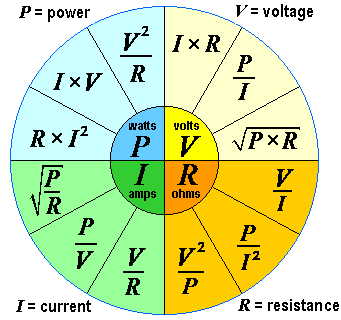
For those interested, it may be calculated using Ohm's Law: ( R ) [ R = V
÷ I ] R (Ω) = V (volts) ÷ I (amps). Our Power Meter option allows you
to view Watts, amperes and volts in real time and may be seen at www.econvergence.net/Power-Meter-for-the-Pedal-A-Watt-p/pawpm-1.htm
ConvTech OK so you're saying that it's hard to pedal if there is greater resistance in the battery based on it being more charged up. And so then - what is not clear is that pedaling at higher gear RPM will increase your volts but it won't enable you to pedal with greater force. "you may change gears when climbing a hill " So the load from the battery draw is greater when the battery is more charged up since its resistance then increases? Or is it the opposite because the battery will pull or suck in more power when it is not as charged up - and therefore the generator resistance going out will be less? And most importantly - if you are pedaling at 90 volts - does your 12 vdc regulator then step down those volts to then increase the amps going into the battery? Or are you saying the pedaling volt level (say 60 volts) will change so that when the battery resistance is low due to it needing more charging then it's load draw will be less - so you can pedal with higher bicycle volts and the battery will draw those volts down closer to 14 volts? thanks
ConvTech
Voidisyinyang Voidisyinyang Thank you for your interest in the
Pedal-A-Watt. A battery that is fully charged offers very little
resistance as it is not drawing many amperes from the Pedal-A-Watt and
it is easy to pedal. A battery that is totally discharged will pull more
amperes as it charges from the Pedal-A-Watt and will be harder to
pedal. Yes, the 12 vdc regulator/converter ensures that the output
voltage is 14.1 volts DC and in your example decreases the input voltage
from 90 volts DC and increases the amperage to keep total output
wattage the same as the input wattage (Remember, Watts = amperes x
volts).
Great to hear! Thanks for your concise, straight forward explanation. So
that explains to me that the battery energy draw is based on volt level
because for example if I use a multimeter on volts then it is very easy
to pedal as there is very little draw from the multimeter. But when I
switch to amps then there is great resistance from the multimeter -
because it also has no load for the amps as well. So as you explain when
the battery is loaded up with amps it is easier to pedal because it is
the volts causing the draw, not the amp level.