Permanent Gorilla Tape All-Weather is a heavy-duty waterproof duct tape engineered with a high-strength butyl adhesive and a weather-resistant shell....Butyl adhesive can stick to leather, but it creates a semi-permanent, highly flexible, and sticky bond. While it will adhere, it is not recommended for heavy-duty or structural leatherwork....
Why did I order another pair of work boots? I wanted a boot that did not have the sole breaking apart from the seam - my current pair has a stitched sole so I could get it repaired. But my outer sole is also not the original traction (I cut off half of the logger heel) - there's huge holes in the traction and so anyone doing a repair would want to put on a new traction outer sole. That would cost as much as a new pair of boots.
Besides the outer leather is wearing out despite my constant use of mink oil and "tuff toe" type paint or asphalt on the toe... And most importantly - the boots are heavy and hot due to the insulation and also the thick outer sole.
Despite all the above problems the boot is very comfortable and strong - unless there is catastrophic failure of the stitching on the one sole around the heel area where it is starting to separate....
The Georgia Giant work boot got redesigned in the 1980s apparently when the manufacturing was moved abroad. The Georgia Logger boot and Georgia winter boot (with toe insulation!!) are what I already have - both are very comfortable and very sturdy. The Georgia work boot called "Giant" gets lots of bad reviews but some good reviews yet even the good reviews admit the boot sole wears down fast - barely lasting a year of full-time work.
A new, stronger sole - vibram - can be sewn on but for the same price as replacing the Giant boot with the sole that is lighter. The idea is that the Georgia Giant work boot is lighter and also less insulated - so less hot to wear, despite being less comfortable.
I got the 8 inch taller boot for more ankle support
And that extra two inches of ankle support is probably the redeeming factor. Why? Here are the main design problems with the Georgia Giant work boot:
The first thing I noticed is the toe box has a separate stitch for the tongue - and also where the steel toe ends. The steel toe in the other boot is under more insulation and thus better protected for better comfort. In this case the top of your foot is rubbing against an edge of steel and that thin fabric separating your foot from the steel edge? It doesn't last, as per reviews - thus making the steel break through as a danger to your foot. The stitch seam where the tongue starts rubs against the top of the foot... so that's two places of weakness in the toe area - and on top of the foot...
The second problem I noticed - and reviews confirmed - that the sole provided is not comfortable enough as an inner sole lining - yet it can not be removed! It is glued to the outer sole as one piece. Yet if you add another inner sole then the boot is too small of size...
The third problem is the stitching on the heel - it has no cushion insulation lining and so there is raw hide stitching rubbing against the heel - causing pain.
The fourth problem is the eyelet on the side of the shoe - the rivet is not covered up internally and reviews confirm this causes severe pain against the ankle bone. One person simply cut out that eyelet and rivet, thus creating a hole. Another person taped over the rivet on the inside.
The fifth problem is the polyurethane outer sole wears out fast and also cracks and crumbles from water moisture as an internal reaction. Even the tread on the sole is very shallow and so it is obvious that the tread would not last. One person cuts a new tread into the sole - and I will do the same, assuming the sole doesn't break apart from internal moisture reaction first (hydrolysis).
Water molecules in the air (humidity) slowly penetrate the microscopic pores of the PU, breaking down the molecular bonds and rendering the foam brittle ...
not as bad as the Eva sole!
An EVA outer sole is made of Ethylene-Vinyl Acetate, a lightweight, rubber-like foam. ...EVA (Ethylene-Vinyl Acetate) is the most widely used cushioning material for insole liners and footbeds across the footwear industry,
The sixth problem appears to have been fixed - there were multiple complaints of the rubber outer lining peeling off, and thus catching the rain as a side basin on the boot. I checked - and especially where the toe bends - this flexes that rubber lining. But that rubber lining (an outer band above the sole) is now sewn in - and not just glued on! So that appears to be fixed.
OK so last night I looked at boot liners to try to solve multiple problems at the same time (the side eyelet, the heel, the toe steel and the inner sole). Today I just found two different boot liners that I had saved in the garage (from older boots that I keep around for precisely this reason - to salvage boot parts!)... Unfortunately even with the thinnest liner - and yes it was remarkable thin and thus ideal as a boot liner - it was just a bit too tight! I definitely could not wear socks.
Some people wear two pairs of socks to stretch out the boot. One person recommended a soup can to lift up that toe bend - but with the steel toe that is not going to bend up easily. I stuffed a couple soup cans in but I was not "stretching" anything out. I suppose I could try to hammer or wedge the steel toe to be wider? I don't think so - it would deform the whole boot - the shank and all.
OK so this leaves me with the solution I first started out with and that has worked so far - because I do have the 8 inch ankle support, therefore I can tie the boots very loose yet high up. So I leave lots of slack and breathing and moving room yet I still have enough support for the boot to do its job. This has worked so far for two days of mowing work - so maybe four hours of uneven hilly terrain that I mow. I take lots of sharp corners and move around with my weight - and I did fine with a loose - and NO use of that ankle bone eyelet - I leave that one alone....
Is that solution - not just the simplest but also sufficient? there is still some callous blisters forming - as people in reviews have reported. Some people stopped wearing the boots after three days due to blisters being so bad!! Some people said the boot was very comfortable?! Why the variation? Again if you get the boot too big you could fit in a 2nd inner sole to increase the comfort. Or you could wear thicker socks or two socks... but I thought the boot would be too big yet the size is just right for one sock (not a thick sock even)...
There is a heel insert patch that I can get to prevent the heel stitch from rubbing. And there is also mole skin that I can put on the steel toe edge - and on the inner ankle bone eyelet rivets....
I think I'll first try my Gorilla Glue thick all-weather rubber tape to see if that provides enough cushioning against the rivets and stitching and steel. I don't have a lot of wiggle room.
OK I just put in 13 pieces of Gorilla Glue tape in one boot and left the other boot - stitched them up and the difference was subtle yet noticeable. I think that Gorilla Glue tape will work - I had to add more tape when it was getting pulled off from putting my foot in the boot....
OK I would still like a little bit more cushion on the bottom but I would have to get those "ultra-thin" shoe liners... since I don't have any wiggle room....
OK I ordered ultra then EVA inner sole liners.... now I need to tape up the 2nd boot with the Gorilla Glue All-weather tape...
I do appreciate that this new boot is lighter and not as hot... and that was my goal. Also the sole is not tearing off and the leather is in better condition - but I sprayed on asphalt to protect the toe and the asphalt spray says TACKY!! Very fascinating - it does not dry hard. It's not as greasy nor slippery as lanolin oil - so I'm happy about that. But I need to use the epoxy paint so the asphalt doesn't keep rubbing off...
OK I just took a quarter mile walk with the Georgia Giant boots on and the left boot that had the Gorilla Tape definitely felt more comfortable!!! So that inspired me to put another 13 pieces of Gorilla All Weather Tape in the right boot....
I feel better now - like I could tie up the boot tighter as I did just now for the walk. I used the ankle bone eyelets and it was no problem for the left boot....
The only problem left is the sole either cracking from hydrolysis - getting brittle and crumbling apart - OR the sole wearing down too fast (in which case I can cut more tread into it)....
Since we normally are not that humid for weather then hopefully the hydrolysis won't be too bad. It is very humid currently but it should pass...
OK so there is a Georgia Giant 8 inch Revamp that addresses the above design problems!! Wow very fascinating!!
toe box material cracked and broke and interior liner wore through after only light use....3 months in and the soles are already breaking down.... I have to say they are the most comfortable boots I have ever had. They have good padding in the bottom-foot area and yet when I climb ladders they give me a lot of support.
yeah so maybe their Revamp isn't working out? It's not a steel toe...and the sole doesn't have that extra rubber lining around it? hmm. wow - the sole is just GLUED between the inner and outer sole!! No wonder they're so cheap - only $80 compared to $150... So a lot more comfortable but they break real fast! So the Revamp was released six years ago...
I bought this 2 weeks ago and didn’t last me 5 days when the bottom sole was already flopping around so I had to glue them , at least they’re comfortable....They started falling apart in less than 90 days. Would not buy again. Sent in a complaint. Got no response. My husband is gluing them together with shoo-goo so he can wear them to work tomorrow.

that person got a refund and no one else has reported the problem.... but still there is no steel toe for this boot. Yeah I think the outer sole is GLUED to an EVA middle sole.... wow. Fascinating.
While the outer sole is cemented to the EVA midsole for a flexible, comfortable foundation, the upper is securely stitched to the welt to ensure structural durability
Yep AI confirmed it.
OK I will glue the previous boot together with the below.
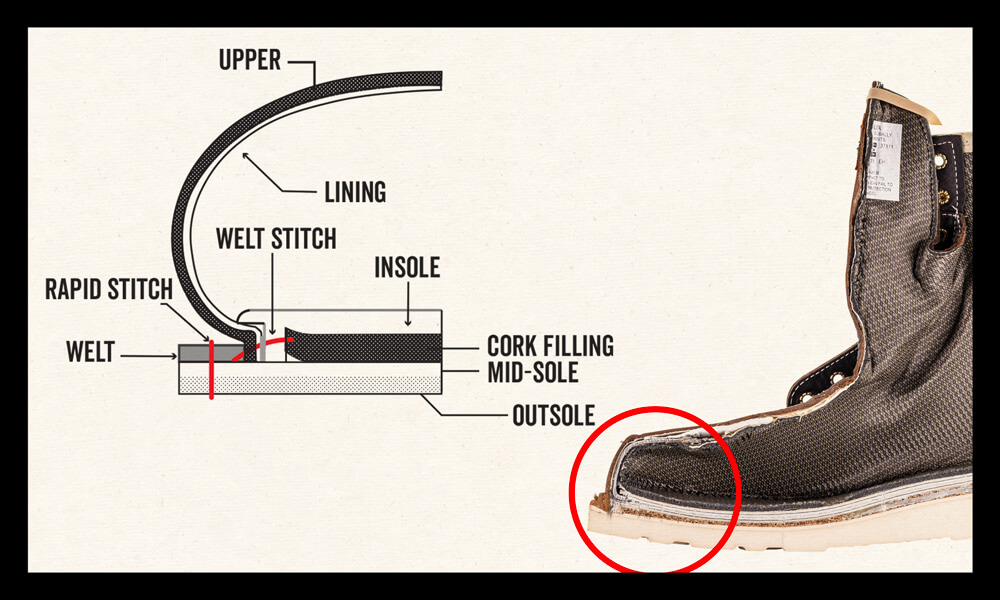
- Shoemaking & Repair: It is the foundational component in Goodyear welt construction, which stitches the upper, welt, and sole together
No, the Georgia Boot Homeland collection does not use Goodyear welt construction... Instead, they are built using a direct-attached construction, where the shock-absorbing PVC outsole is chemically bonded directly to the upper soles
split across the ball of both feet, all the way through. That short of lifespan over rides any good quality.
PVC (Polyvinyl Chloride) outsoles on boots are common, especially in brands like Dr. Martens, but they frequently split due to cold temperatures making the material brittle, or wear-and-tear causing the heat-welded seams to fail
OK....
Yes, the Vibram sole on the Georgia Logger boot is cemented (glued) onto the midsole using industrial-grade adhesives. [1]Even though the boot features a durable Goodyear welt construction where the upper, welt, and midsole are stitched together, the outer rubber sole itself is glued. This makes it possible for a cobbler to remove and replace the outsole when it wears out...
I had a different style g[E]orgia a while back which did the same but those had a glued sole and the sole wore out and detached in less than a month went throu like 10 pair through the 6 month warranty.
wow!!!
to completely remove old cement glue from a Vibram sole, soften the adhesive with a heat gun, scrape it away, and sand or dissolve the remaining residue. This ensures a clean, textured surface for a strong new bond...Yes, using a hair dryer on high is a highly effective method to soften and heat-activate contact cement on Vibram soles. It temporarily weakens the adhesive bond, allowing you to easily pull back the sole for repairs or safely remove it for a full resole
OK I ordered the Vibram Logger Sole - to glue onto my logger boots.
- Prep the surfaces: Scuff both the welt and the top of the Vibram sole with coarse sandpaper (around 80-120 grit) to create a rough texture for the glue to grip. Wipe away all dust. [1, 2]
- Clean: Clean both surfaces thoroughly with Acetone to remove any remaining oils or factory coatings. [1]
- Apply the glue: Apply a thin, even layer of E6000 to both the welt and the Vibram sole. [1, 2]
- Wait for tackiness: Let the glue sit for 10 to 15 minutes. It should feel tacky and not stick to your finger when lightly touched, but transfer no wet glue. [1, 2, 3]
- You will need about 1 to 2 fluid ounces of Barge All Purpose Cement to glue a full pair of Vibram soles. Because contact cement must be applied in a thin, even layer to both the bottom of the shoe and the sole, a standard 2-ounce tube is usually the perfect amount to cover a full pair of boots while leaving a little leftover for touch-ups. [1, 2, 3, 4]
-
 The Step-by-Step Bonding ProcessProper surface preparation is more important than the specific glue brand for ensuring a lasting hold. [1]
- Rough the surfaces: Use heavy-grit sandpaper to buff both the bottom of the shoe and the top of the Vibram sole. This creates texture for the glue to grip. [1]
- Clean debris: Wipe away all rubber dust using rubbing alcohol or a specialized shoe. [1, 2, 3, 4, 5]
- Apply the glue: Using a brush, apply a thin, even layer of contact cement to both the shoe and the outsole. [1, 2]
- Let it dry: Allow the glue to dry for 10 to 20 minutes until it feels tacky to the touch but does not come off on your finger. [1, 2, 3]
- Press together: Firmly press the outsole exactly into place. Contact cement bonds instantly, so precise alignment is critical. [1, 2]
- Clamp and cure: Tap the sole with a hammer to lock the bond, then clamp or wrap the shoe tightly and let it cure for 24 hours before use
- I made sure to get it all over everywhere I wanted it to stick. I lined the shoe up and as I was coming down..... the heel hit first and it was a little disaligned. At this point I realized that this contact cement was going to work very well. Because I had a hell of a time getting that soul off so I could realign the shoe, but I did. This stuff bonds immediately. Yes I went ahead and clamped it and made sure that everything made contact that I wanted to have stick. But I don't think that this sole is coming off this boot.... Until it wears down. Once it bonds it is sort of a clear yellow color. And if you have to pull it apart it turns white from the stretching.

No comments:
Post a Comment