Friday, August 20, 2021

Revisiting Alain Danielou's claim that the word God originates from "Bull" in Sumerian!!

 PIE root *gwou- ox, bull, cow.

 https://www.thefreedictionary.com/_/roots.aspx?type=Indo-European&root=g%ca%b7ou-

 So it appears Alain Danielou is the only one making this claim.

a Brahman bull, steer, or cow.

Origin of Brahma

3
First recorded in 1935–40; alteration of Brahman

Wow that's very recent!!

 It's all the same to them whether they kill a bull as a sacrifice or sacrifice a human being;
In Egypt living bulls were venerated as incarnations of a god
https://brill.com/view/book/edcoll/9789401206358/B9789401206358-s030.xml

AN INDO-EUROPEAN CUSTOM OF SACRIFICE IN GREECE AND ELSEWHERE

In: Evidence and Counter-Evidence: Essays in Honour of Frederik Kortlandt, Volume 1

Author: Norbert Oettinger

 In Armenia, a black bull was associated with the thunder god 
In the later Śatapatha Brāhmana, both a primordial bull

 http://sumerianturks.org/bull.htm

And in Sumer (starting around 4000 BC), bulls represented sun and sky gods, their highest gods. So, there is a continuity of bull cult f

 Cattle was first domesticated from wild aurochs in the Taurus mountains in Southeastern Turkey, not far from Gobeklitepe, some 10,500 years ago!

Aurochs were big animals weighing up to half a ton and with heights up to 180 cm. No wonder they inspired awe among the people of Gobeklitepe. Imagine how important it was for the people living in the region to have domesticated these big animals.

 Not too far from Gobeklitepe, neolithic site of Catalhoyuk had a bull cult about 8000 years ago. We find a bull cult in the indigenous Hatti civilization in Turkey (Anatolia) some 4500 years ago.
And in Sumer (starting around 4000 BC), bulls represented sun and sky gods, their highest gods. So, there is a continuity of bull cult for civilizations in Turkey and Mesopotamia for thousands of years.

Aurochs / Bulls are the biggest animals ever domesticated apart from the elephant.

 Bull cult is found in ancient Anatolia / Turkey, Sumer (Iraq), Transoxiana (Turkmenistan), Maykop (Russia), Indus Valley (India / Pakistan), Egypt, Levant, Greece, Rome (Italy), Celtic, Gaul mythologies in Austria, France, Ireland and beyond. It is the most important cult spanning thousands of years (probably 10,000) and a large part of Eurasia.

 Sumerian Gud is ox.

 Ah written by the author of a book on the  Sumerian roots of IndoEuropean language!!

Fascinating.

One recalls immediately the epithets of Indra (vṛšabha- and š bh -, both meaning ̳bull‘) and the fact that the Greek master of the thunderbolt, Zeus, also has a strong connection with bulls
(in the shape of a bull he impregnated his mistress Europa). But, on the whole, it appears that Hittites, as well as Indo-Europeans, worshipped their gods in the human shape, but that, being
very powerful, the gods could, if they wished, change their shape into particular animals.

 https://i.4pcdn.org/tg/1480929855646.pdf


  • Celtic (in this case Irish) texts were written down between the 11th and 14th centuries CE. In one myth a bull is killed and dismembered by another bull and the parts of his body are distributed around Ireland, which explains the names of many features of the

landscape, though not the cause of their existence. "It was not long before the men of Erin [Ireland], as they were there in the company of Ailill and Madb early on the morrow, saw coming over Cruachan from the west, the Brown Bull of Cualnge with the Whitehorned [Bull] of Ai in torn fragments hanging about his ears and horns." An example of one of the distributions is this one: "Then he raised his head, and the shoulder-blades of the Whitehorned fell from him in that place. Hence, Sruthair Finnlethe ('Stream of the White Shoulder-blade') is the name given to it." The original source is the last chapter of the Táin Bó Cúalnge, usually called in English, The Cattle Raid of Cooley. These quotations are from The Ancient Irish Epic Tale, Táin Bó Cúalnge, transl. by Joseph Dunn, publ. David Nutt, London, 1914.

  • In Lithuanian, a folktale tells of a bull and 3 cows which are beheaded by Aušrinė, (the morning star) and then the land appears. "The maiden upon returning released her bull. The bull knelt down and spoke in a man's voice: "Chop off my head!" The maiden did not want to chop it off, but she had to. She chopped the head off—a fourth of the seas disappeared, became land. Her brother emerged from the bull. She cut

off the heads of all three cows, who were her sisters. All the seas disappeared, turned to land. The earth sprang to life."

 https://sindhueuropayom.fandom.com/wiki/Proto-Indo-European_religion#Bulls

 In another document from Mari Ninigizibara is said to have been deco-rated with silver and gold.󰀹󰀵 This goddess is finally referred to in first-millennium god lists as a gu4-balaĝ “bull-balaĝ” of Inana.󰀹󰀶

 http://sumerianshakespeare.com/30301.html

The sign is gu4, pronounced gud, the sign for "bull".
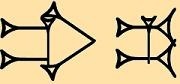


 The usual form is on the left. It still retained much of its early pictograph appearance (it looks like a bull head). On the right is the compressed form. The large triangle has been replaced with two smaller triangles, "reverse cunei", facing in the opposite direction, and the vertical line has been moved to the horn area.


A translation of Tablet #36 in the Library of Congress. The world's first political satire,
the first dark comedy and murder mystery. A literary masterpiece that was
 written by
a Sumerian Shakespeare.

However, it seems the Sumerians were distinct from the Semitic neighbors that surrounded them (the Akkadians, Elamites (Iranians), Gutians, Hamazi, etc.). It's highly improbable that the Sumerians were ethnically the same as their neighbors but spoke a language that is completely different. Not only was their language different, but their statues and portraits suggest the Sumerians were Caucasians, who originated from the area around the Caspian Sea. The Semites, on the other hand, originated from the Arab Peninsula. Remarkably, the Sumerians were later able to maintain their ethno-cultural identity during two centuries of Akkadian domination (2350 – 2150 B.C.)

 The Sumerians themselves did not arrive until about 3500 b.c.e. from their original home, which may have been in the region of the Caspian Sea.

 https://atlantipedia.ie/samples/tag/jerald-jack-starr/


The king of Uruk. He stands at the Tree of Life which blossoms with eight-pointed rosettes.


Gudea and Ur-Namma, two great kings of Sumerian history (circa 2100 B.C.). See an enlargement of Gudea, and see Ur-Namma at the dedication of a new temple.

The crowns of Gudea and Ur-Namma are stylized versions of a shepherd hat. That’s because a shepherd was considered  the ideal role model for a king (see The Shepherd Kings on this website). Sumerian kings were routinely described as the shepherds of their people. Their crowns were doubtlessly taller and more grandiose than a real shepherd hat, which gave the kings greater stature and made them seem more regal. The shepherd crowns of Gudea and Ur-Namma were particularly extravagant in this regard, but the crowns of many other Sumerian kings were more modest in appearance. Their crowns more closely resembled the original hats worn by shepherds in the field.


The reigns of Gudea and Ur-Namma occurred at the end of Sumerian history, but I would suggest that the Sumerian ideal of shepherd kingship was established in the Uruk Period (circa 4000 – 3000 B.C.) at the very beginning of Sumerian history.


The shepherd kings of Uruk:

Uruk was the first large city in Sumer (and in the world) so it was literally the beginning of Sumerian civilization (“civilization” is derived from the Latin word “civitas” meaning “city”).
Uruk and other Sumerian cities grew up around the first large temples in the region, so the cities were originally administered by the high priests. Later, as the city-states became more powerful and competitive, they were ruled by kings who could better deal with the mundane, more down-to-earth matters of civic administration. Kings could also command large armies to fight against other Sumerian cities and to guard against foreign invasions. In the interim, according to the prevailing theory, after Uruk was ruled solely by priests and before it was  later ruled by kings, it was governed by the “priest-kings”, so-named because they were often shown performing both kingly and priestly duties.


A statue of the “priest-king” of Uruk, frontal and three-quarter views. The statue is part of a matched set that is dated in the Uruk Period. The nude statues are rendered in a very simple and abstract style (click here to see a picture of both statues).

According to the Louvre, where the statues are kept, “On the head of the priest-king is what seems to be a cap or headband” and the beard is “continuous with the hair”. There are no striations on the top of the head to show that it is hair, but then again, there are no striations on the beard either. The simple abstract style of the figure makes it difficult to discern the exact nature of his headdress. In many depictions of the priest-kings of Uruk, one could argue that he is wearing a hat, or a headband, or a hat with a band. I would suggest that it's a hat, and not a headband, for the following reasons:

1) A headband is generally associated with the crown of an Akkadian king, as seen on the statutes of Lamgi-Mari and Sargon. Sumer and Akkad were two distinct countries that were often at war with each other, so it seems unlikely that both the Sumerian and Akkadian kings would wear the same kind of crown.

2) If a headband was the crown of the prototypical Sumerian king, it seems that the same
crown would show up in other Sumerian cities, in other periods of history. But there aren’t
any known examples of later Sumerian kings wearing a simple headband as a crown,
not even in Uruk.

 3) A headband wasn’t worn by Sumerian priests. Later portraits of Sumerian priests were traditionally depicted in the same manner. They were often nude, they poured libations from the same spouted pitchers, and they didn’t wear any kind of headdress (as shown on an engraving, a plaque, and the Vulture Stele).  On the other hand, throughout Sumerian history, a simple headband was usually the headdress of a female priestess (see the priestess of Ninsun and the high priestess of Ur, to name just a couple) but the headband is never shown on a male priest. It seems that if the headband was the mark of a male priest, then some other examples would have shown up in Uruk or elsewhere.


In light of the evidence, I propose a new theory about this statue of the priest-king of Uruk.
I have never heard it mentioned before, but I would suggest that he wears a shepherd’s hat with a domed top and a thick brim. It is not as elaborate as the shepherd hats of Gudea and Ur-Namma, but it probably closely resembled the rustic caps worn by ordinary shepherds. Early versions of the shepherd hat, like this one, had brims that were thick but narrow. Some other examples are shown on the seal impressions pictured below.

I also suggest that this "priest-king" is not a king at all, but just a priest, because he is nude. The Louvre states, "This nakedness is probably connected with the figure's participation in a particular ritual - most likely a form of fertility cult." Although the priests are sometimes nude, it's not fitting that a king be shown naked. It would be injurious to his gravitas. In my opinion, the Uruk priest is not a priest-king until he put his clothes on.

For the sake of reference, the ruler of Uruk is a priest when he is shown naked, he is a
priest-king when he wears the ceremonial netted skirt of Inanna, and he is a king when he wears a regular skirt.

I would further suggest that the shepherd, which is clearly the model for Sumerian kings, was originally the model for a priest. Like a true shepherd, the priest gathers his flock (the people) at the temple and he administers to their needs, which is why a priest is often referred to as a shepherd in many religions of the world. The shepherd priest of Uruk would later become a shepherd priest-king, who then became the shepherd king − the ideal Sumerian king and the prototype for all other Sumerian kings.


A priest-king of Uruk. The dome of his hat is very high, taller than where the top of his head should be. The thick brim is pulled down low on his forehead. There is a hatband incised above the brim. From this angle it is obvious that he is wearing a hat…


…from this angle, it is not so obvious. Now his hair looks like a headband, or he is wearing a stylized chignon, and the hat and the chignon are not differentiated.


Drawing of a head (Uruk). The notch in the back is either a ribbon used to tie his chignon − or the hat is lower in the back (like the one shown above) and his chignon is below it. The artists of Uruk were not always precise about delineating the beard from the hair, or the hair from the hat, or the hat from the band. That is why there has been some debate about the nature of his headdress. Fortunately, not many images of the priest-king are quite so ambiguous as this drawing and the statue shown above. The shepherd hat is more obvious in a reconstruction based on the surviving fragments, as shown below.


Early versions of the shepherd hat looked like this. It was essentially a wool cap with a rolled brim. From this angle, it is easy to see why the hat has been mistaken for a headband.


The Blau Monuments:
 

Enlarge.

The Blau Monument from Uruk. The proto-writing on the Blau Monument is not translatable and the purpose of the artifact isn’t known.

According to the British Museum, “The two stone tablets seem to form a pair, though it is not
fully understood what they were used for, and what they mean. However, it's widely accepted that they record a transaction in which land was exchanged for various goods…“ The Blau Monument may “thus represent an early form of Mesopotamian kudurru or boundary stone”.

It is said that the two parts of the Blau Monument belong together, but I don't think this is true because the king is dressed differently on the separate parts. Neither do I believe that the pieces are by the same artist, or that the separate parts even belong in the same time period. Anyway, I'll save that discussion for another webpage. In the meantime...


There are two views of the priest-king on the Blau Monument, as shown above. On the left, he holds an unidentified object and he is clearly wearing a shepherd hat. On the right, he presents a lamb or a goat, perhaps as a sacrificial offering. The outline of the shepherd hat isn't very obvious, but the notch on the back of his head that delineates the hat's lower brim shows up better in an enlargement. Judging by the writing, this part of the Blau Monument is much older than the part on the left, and the above two pictures show how the brim of the hat became wider over time until it resembled the later versions of the shepherd hat. The narrowness of the brim in the early depictions of the Uruk king is probably why his headdress is often mistaken for a headband rather than a hat.

It's not just the hat that identifies the Uruk king as a shepherd. He is also involved in the
care and feeding of animals.


Uruk cylinder seal impressions of the shepherd king:  


The shepherd king and a priest feed the sacred flock of Inanna. He wears the ceremonial netted skirt of Inanna. She was the goddess of war and the patron deity of Uruk.


Another image of the shepherd king feeding the sacred flock of Inanna. Her looped standard with streamers is clearly visible in the middle of this seal impression.


And yet another image of the shepherd king feeding the sacred flock of Inanna.


Here the king is carrying an animal, and another animal is in the background. The priest carries a ceremonial spouted pitcher. The baskets of food represent abundance.


Again with the animals. It seems animals are always in the presence of the shepherd king.


A cylinder seal impression showing the shepherd king with pigs/wild boars (sipa, the  Sumerian word for shepherd, means a herder of any type of animals, even pigs). The shepherd carries a staff. With him are a couple of dogs (hunting dogs, shepherd dogs?). Shepherd dogs are mentioned in Dumuzid’s Dream on the ETCSL, lines 95 - 97.


A similar seal impression showing two swine and four dogs. Two of the dogs are on a leash. Sipa also refers to a herder or keeper of dogs.


The shepherd king holds the branches of the Tree of Life while rams feed on its eight-pointed rosettes. A lamb is shown in the background. The rosettes were a sacred symbol for the Sumerians and the image of rams feeding on the high branches became a common motif in ancient Sumer.

Enlarge.

The shepherd king on a ceremonial barge. He has a sacred statue of a bull, or a bull altar,
or maybe it’s just a bull, and the structure represents a pavilion in the background
on the shore. Even when he’s on a boat, the shepherd king has an animal with him.

So what’s with all the animals? Surely it’s not to show that the king is a goodhearted person because he is kind to animals. Of course some of the animal images could relate to his functions as a priest – feeding the sacred flock, offering sacrifices, etc.; but other Sumerian kings, like all kings in the ancient world, also had priestly duties. They are shown performing religious rites, meeting with the gods, and dedicating new temples, but they’re not constantly surrounded by animals the same way as the Uruk king. The continuous presence of animals
in the iconography of the Uruk king is meant to establish his identity as a shepherd, as the guardian and protector of his flock, the people.


We all need to Get Out back to the Cosmic Mother!


 @Voidisyinyang Voidisyinyang  you speak so holy, but because you hold valuable information, what are you doing with it, racist? Why are you standing on stolen land? Get OUT!!!

Mother Nature owns the land and yes we are all being kicked out - probably in about five years - due to abrupt global warming. The arctic is to be ice free for the 1st time in 3 million years - in a few years. Then the East Siberian Arctic Shelf (ESAS) methane bomb goes off - and that will double global warming. Soon it will be too hot to grow food at scale. Then the nuclear power plants will meltdown, etc.

I did have a dream in 1995 that was more real than being awake - of my Earth First! activist friends standing on the roof of a house with Native indigenous activists - they were hanging a banner to protect the sacred forest. Then in 1998 I got arrested for the Minnehaha Free State - and there was a newspaper photo of the precise same dream. Suddenly I got this uncanny sensation as the newspaper photo triggered my memory. I had long since forgot the dream that was MORE real than being awake so I drove up to my parents to find my own journal. I had written the dream down at 2:30 a.m.
 
When I had gotten arrested - at the time that was the biggest police raid in Minnesota history - to evict the native activists. I had delivered a research paper I wrote for Winona LaDuke's class at the University of Minnesota - on environmental racism. University of Minnesota Professor William Fowell was a history professor and his history of Minnesota book states that the Treaty of 1803 that had ceded over that land from the Dakota - was not valid. Pike was not an authorized agent of the government to sign treaties and instead he just handed out some 40 jugs of booze to get the treaty signed. 
 
So then the native activist - Jim Anderson - he walked over to me in court and said, "I wish I had known that information before." I had told the judge this information at our court case but I had also delivered copies of my paper to my Earth First! activist friends. But the white activists were too fixated on some kind of military confrontation with the cops - and so when I asked them to give the research to the native activists - it never happened.
 
"Reclaiming ancestral homeland begins healing process for Dakota people in southern Minnesota. Robert Larsen has waited years for the Minnesota Historical Society to return 114 acres of land to the Dakota people of the Lower Sioux Indian Community. When the unanimous vote finally came this year, Larsen was watching on his computer. As soon as it was official, he drove to the spot off of County Highway 2, east of Redwood Falls.

He said a prayer, sang a song and made an offering of tobacco.

“Steps towards healing is what we need,” Larsen, the tribe’s chair, said. “And this is one of those steps.”
 
The historical society bought the property from private landowners starting in the 1960s. Its return to Lower Sioux Indian Community was a culmination of talks that began in 2004. Local government officials were skeptical about the change, Larsen said.

The land transfer ultimately required the involvement of the state Legislature, the Minnesota Department of Natural Resources, the federal government and 31 different tribal nations."

As for me - the first time I got arrested was in 1994 to protest the storage of nuclear waste on a native reservation on the Mississippi river. There were tribal drummers there and then this hawk flew overhead and the security guard tried to stop us from getting into the corporate headquarters of the nuclear utility company. I got the door open so everyone could get it and then I heard myself singing the same native singing that the drummers were doing. This surprised me but I did do a lot of singing back then as I trained in music.

And so a cop had violated my 1st amendment rights by tearing out my protest sign out of my hands. I got his badge number but since I didn't have any other witnesses - then the lawsuit was never filed. 
 
And then in 1996 when I worked for Greenpeace I was invited by Inila Wakan - a native Lakota activist - to go to Pine Ridge reservation. He showed us the polluted uranium streams from the uranium mining.
Yes the future of humans on Earth will be more two-headed babies from depleted uranium pollution and nuclear power plant meltdowns - with the routine leaking of radiation.
 
So I got arrested eight times in total - all for trespassing. I got kicked out of the US Federal Courthouse - dragged out across the floor - why? To protest against the US genocidal sanctions on Iraq. The Minnesota Congressman Sabo - where we also got arrested - he did change his view to be against the sanctions.
 
Then I spent ten years working at an environmental nonprofit part time while I read one scholarly book a day and I also bicycled an old 3 speed and then dumpster dived food from the bicycle. The cops thought I was homeless but I did rent this run down room. I guess because I was hanging out with the homeless people a lot - mainly native indigenous people around the University.
 
Then I spent a few years removing European invasive buckthorn - with a pick axe and bow saw to heat our house. I planted an acre of chestnut trees and Shiitake mushrooms and berries.
 
So now I grow shiitake mushrooms in the forest and I also inoculate grass with endomycorrhizal fungi - that is to store carbon.
 
And mainly I am waiting for Mother Nature to take revenge with the accelerating abrupt global warming.
 
But I do know that ghosts are for real and each of us has a ghost inside us. So the real question is where do the ghosts go? haha. I know there is something called "Ghost Pollution" and I know the spiritual healers also even heal the ghosts!! This is done through Mother Nature as the Cosmic Mother or the Emptiness. 
 
So yes we all need to "get out" to the Cosmic Mother in order to heal our ghosts internally.
  That is also what Pythagoras taught. Five years of silence is required for the true Pythagorean practice as he was taught in Egypt. So only by listening to Pythagoras (Snake-Master) for five years then do we hear Pythagoras talking. There is a high pitch hissing noise of the kundalini energy that our Original Human Culture - the San Bushmen - call the N/om (snake energy). Then there is a spinning vortex as our spirit leaves our body - this is the Emptiness that Dr. Peter Kingsley describes as also that the Pythagoreans experienced - the spinning vortex is the Cosmic Mother Shakti energy. It happens when our spirit as a ghost leaves our body without enough Yuan Qi or Cosmic Mother energy making a spacetime protection around the spirit-ghost.
The spiritual healing masters then just LISTEN to the Cosmic Mother in Sigh-Lens and so they CREATE new spirits or Original spirits that go into other people to heal those people. The Cosmic Mother makes a NEW original spirit that creates a new healed body for each individual person - through the heart of the spiritual healer in the Emptiness. The spiritual healer then EMBODIES the Cosmic Mother.
Yes this can only be done in silent meditation. Thanks for understanding.

What is a Real "Authentic" experience? My U.S. Minneapolis-based "authentic" Zantigo meal vs. Taco Bell Defy

 I made a rare trip into what an old local here called "Smogopolis" - (a term coined way back in the early 20th century I think).... and I ended up going through the Zantigo drivethrough.


I said I had a "Fistful of Dollars" but the young (teenage) African-american male worker didn't register that reference joke to Clint Eastwood westerns.


So then I see a young Asian-american male "manager" counting my pennies. I'm enjoying the irony of a white male paying with pennies at a Mexican fast-food drive through claiming to be "authentic" Mexican food - while his African-american worker admires the literal DOLLAR coin that apparently neither of them had seen before!!

It was a classic U.S. experience.

Old Minneapolis - A Zapata in 1972! Thanks to Old... | Facebook

Aug 1, 2019 — Lake Street & Girard in Uptown! Zapata changed its name in 1976 to Zantigo. In 1986 the chain was acquired by the parent of Taco Bell and the ...

 Maybe this was "authentic" Mexican originally? That's the neighborhood I grew up in so someone told me about remembering Zantigo back in the day! But I don't remember it.

But  

The Zantigo name evokes memories of 1970s-era Mexican food consumed late at night in your car. But while most were shuttered in the 1980s or became Taco Bells, there are still five locations across the Twin Cities serving up its signature menu item: the simple but apparently habit-forming chilito.
 

 And then it re-opened ....by the same Minnesota white businessmen who created "Chi Chis" - another infamous Minnesota restaurant chain that I used to joke about with my Mexican coworkers. I used to ask them if the Chimichanga was a real "authentic" Mexican meal or not? haha. I'm still not sure - need to search that. 

OK so ...

Zantigo began as Zapata in the late 1960s and was shuffled among various ownership groups as it grew. There were dozens of locations across the Midwest when it was sold to PepsiCo—which already owned Taco Bell—in 1986. Zantigos were converted or closed. Kaelble worked for the original chain from 1975 to 1987.

In the 1990s, the Kaelbles opened a few Zapata restaurants and later discovered that the Zantigo brand was no longer under PepsiCo’s control. When the Fridley spot opened in 2000, they revived the Zantigo name.

“The best compliment is when they say ‘This tastes just like it did when I was kid,’ ” says Kaelble.

 OK so it was a good meal - tasted pretty fresh but as soon as I pulled out of the drive through I saw a local restaurant that had in big letters AUTHENTIC Mexican restaurant - and that one definitely WAS an authentic Mexican restaurant. haha. I didn't go in but you could just tell.

https://www.wcpo.com/news/insider/remember-this-those-cheese-chilitos-at-zantigo-were-to-die-for-

 most of the 82 restaurants in the Minneapolis-based Zantigo chain were converted to Taco Bell eateries by 1987 after Zantigo went out of business.

  Kaelble brought cases full of Zantigo products to Gambill's home and cooked up a feast for him and his family and friends.

"It tasted every bit as great as I remembered," said Gambill.

 That's hilarious that the current OWNER actually did a PR stunt or "visited" a local writer to cook up a home-cooked Zantigo Chilito!

I did not eat a Chilito as I didn't realize that was their "signature" meal.

https://zantigo.com/menu.php

 Anyway the Asian-american young manager informed me I was 20 cents short - and so I handed over another fistful of dollars (or pennies this time) and said,

"Keep the change!"

They actually seemed delighted to get all that change as apparently there's a RUN on real coins these days as people have been hoarding their coins.

Marno McDermott, not to be confused with Dermott Mulroney or Dylan McDermott opened the first Zapata restaurant in Minneapolis in 1969.

 Old Minneapolis - A Zapata in 1972! Thanks to Old... | Facebook

OK this must be a Taco Bell "restaurant" now - I did some full lotus "sessions" in there.  Nope - that one is off 3rd Ave - about 15 blocks to the east.

His operation was purchased by Hueublein, then parent company of KFC, in 1974. Hublein changed the name of Zapata’s restaurants to Zantigo, and changed the name of Zapata’s grocery products to Ortega, a brand which still exists today. Heublein was acquired by the R.J. Reynolds Tobacco Company in 1982, which merged with Nabisco in 1985, after which the restaurant division, including KFC and Zantigo were sold off to PepsiCo, who already owned Taco Bell. As a result, the 80 or so remaining Zantigos were either closed or converted to Taco Bells by 1988. Meanwhile, Marno McDermott had moved on to his next venture, again selling a Midwestern version of Mexican food, co-founding Chi Chi's in 1975, after which, he co-starred in My Best Friend's Wedding with Julia Roberts.

  Marno McDermott (his wife's nickname was "Chi Chi")

 Somehow I don't think Marno McDermott was Mexican-American. haha.

Marno McDermott was a successful Minneapolis restaurateur, opening a chain of Mexican restaurants
https://edinamag.com/rojo-mexican-grill-south-border-cuisine-evolves-edina
The Twin Cities has its own trajectory within the nuevo latino story arc. Our earliest Mexican success scenario belongs to Marno McDermott, of Irish-Scandinavian descent, who opened the wildly popular Chi Chi’s in 1975 in Richfield. Chi Chi’s grew to a chain of more than 250 locations and continues to churn out tacos in Europe, the Middle East and Indonesia. McDermott’s son Michael stepped into his footsteps in the restaurant business; he recently opened his second Rojo Mexican Grill in the Southdale shopping center. “No question about it, my dad is my hero,” McDermott says. “I still talk to him all the time about everything I do. I’m very lucky—he’s a great mentor and a great dad.”
   
The restaurant scene, particularly ethnic restaurants, was very different when Chi Chi’s hit the scene. “Dad started Chi Chi’s in the ’70s; everyone dressed up as mariachi [musicians] and decorated with festive piñatas,” McDermott says.

 Wow times have changed.

Yep. A two-story Taco Bell. Several lanes are dedicated to people who have already ordered using the app. Then there's a lane for regular traffic and a proprietary vertical lift, invented by New Hope-based PD Instore, to deliver the food from above.

 https://www.kare11.com/article/news/first-ever-taco-bell-defy-to-open-in-minnesota/89-84fbed6f-a366-4e89-b22d-c6c5ab79a15b

First in the World!! (invented in Minnesota - youtube video)


Thursday, August 19, 2021

Will the Greenkey Rolling Lawn Aerator get sent from Bangkok or not? Dr. Mike Amaranthus on endomycorrhizal inoculant

 Assembly vid of Greenkey Rolling Lawn Aerator 

Wow it's a PLAYLIST for assembly!!

I spent the night checking out manual lawn aerators as I need to aerator the lawn before I spread the endomycorrhizal fungi spore.


The Importance of Mycorrhizal Fungi with Dr. Mike Amaranthus

He's got several vids - he started MycoApplications business.

So he gives an excellent lecture on the soil science of  applying these spores to store carbon and grow plants.

 https://www.lawnsmith.co.uk/rolling-lawn-aerator

This looked like the BEST manual aerator tool that I could find.

It's demonstrated here - in the UK - it's a uK product 

I didn't know the brand name - I could only find this "fly by night" website - or a couple websites - that sold the aerator!!

I just need holes in the ground so that the spores can get down to the roots.

All the other tools seemed too slow or not as effective.

https://mylawn.store/product/rolling-lawn-aerator

I ordered it from here and a DHL label was created out of Bangkok Thailand!!

 Or so they claim. It's one of those businesses that charges you if you cancel the order....

But claims you get a refund if they do not send the product.

So here is the manual spike aerator on Amazon

Let's now read the reviews.

 very easy to use and efficient as long as the ground is soft
very sharp spikes. keep away when not in use. I have already lost 2 of the protective caps

  however sections move apart in use so 1 nylon washer installed each side remedied this.

 I aerated the whole lawn (a big one) with a garden fork and it took a couple of hours of hard work. With this tool it took maybe 20 minutes at most - and was far more effective. Can definitely recommend it.

 The bolts holding the handle too together are too thin and too short.
The bolts, being thin and short making it difficult to get them tightened

 However, if you slip a couple of 4Kg barbell weights over the handle it works very well and is easy to operate.

 Ah good to know. so 20 pounds of weight?

Pushing the roller tends to rip up the turf as the spikes, imbedded to their full 2in length, pull out and tear the grass. Pulling the roller gives much cleaner holes and is much less work.

 my major criticism is with the assembly of the studs. It took me almost two hours and a lot of effort to make sure that all the studs were screwed in fully, and there are still a couple that I couldn't fully screw in. The studs should come already assembled. A very frustrating assembly.

 Ah good to know!


Good luck assembling this thing. The plastic channels don’t hold the bolts tight enough so they spin. You will then have to grab them with pliers, but they will slip and massacre your hand. It works well once assembled but expect to lose a bit of skin and possibly your temper in the process.

  however, three of the nylon lock nuts did not tighten up successfully which meant that they were loose on the rollers which sadly tears up the lawn due to the angle they are going into the soil. Should include spares in the package. Also the supplied spanner is pretty much useless as it barely gripped the nuts when tightening.

 It could just be my lawn (it was very damp) but in areas it was hard to push and the metal cross-piece bent down towards the spikes and I had to bend them back as the spikes caught the metal and stopped the thing turning. this was not too much of a problem but the cross-piece could do with strengthening fillet across the angle.

Having looked at all the aerators on the market, I chose the Greenkey rolling lawn aerator because, unlike electric aerators, it does not cut up the grass roots and the kill the worms in the soil. As an engineer, I very much appreciate the way it has been designed and manufactured. Every piece fitted together perfectly. I only hope it was made in the U.K.

Decent quality but could do with spring washers or locknuts on the spikes as they loosen all the time. A decent workout even on wet lawn ! Use exactly as shown on video.

  I may have overtightened some of the spikes which compressed the plastic and some of the spikes are not totally upright. I did this as some people say that the spikes can come loose.
Anyway I used it when the day after a heavy shower when the ground was softer. It worked really well and the lawn looks better some weeks later. I will use it regularly to let air, water and fertiliser get to the roots and to hopefully prevent compaction of the lawn. Limitations are that it only spikes to 2" so wouldn't have much effect if the compaction was deeper in the subsoil.

Very effective & I am truly glad I bought it. Makes great slots in the soil which will not only aid aeration & moisture absorption, but make over seeding a dream. I am over 50 & not at peak fitness but I even look forward to the gentle workout as well.

 Excellent reviews.

The T bar handle does make it easy to use, but I did have to add weights, 15 Lbs. to be exact, for better traction. For best results, use this product after the ground has been wet. I used it a day after heavy rain and it worked like a champ. Okay, for full disclosure, I totally hate yard work with a passion, but I do enjoy working out and you will get a work out using this product on your yard.

 Get the correct size spanners or a good quality small adjust able spanner. You will also need a small Vise Grip or Mole Grip to hold the spikes while you tighten the securing nuts. Some of the spikes will lock into the wheel but I had to use the Vise Grip on about half of them. Once assembled there was to much play on the shaft that located the spiked wheels, so I made a thick felt washer to take up the play. Had I not have done this then I suspect the wheels would not have locked together as they should have done. I was inspired by G Burrows review and his method of adding weight to the unit.

  B) the slots into which the spikes locate are sometimes too big for the hexagonal spike head so tightening them without additional tools is impossible (see under).
III. Tools. To assemble it properly you will need 3, different sized, open end or ring spanners one for the nuts holding the handle and axle in place, one for the lock nuts holding the spikes in place and one for the nuts used to bolt the shaft, handle and spike wheel bracket. You will also need a Philips screwdriver and long nosed pliers, the latter to locate and hold in place the bush which fits inside the bottom of the shaft at the bottom bolt position. I used two small shifting spanners for the nuts plus a pair of vice grips to hold the spikes in order that the lock nut would be tight enough. If the spikes are not sufficiently tight there is a high risk that they will wobble and snap the fittings on the wheel. May I suggest that when fitting the spikes you put the ‘protectors’ on before attempting to tighten the lock nuts. If you don’t and the spike slips it could easily cause a serious injury.
IV. If you are not a DIY expert don’t attempt to build this yourself. It is relatively straightforward but, as I have said, could be dangerous so get someone to assemble it for you.

 VI. Finally It is a good tool. The metal parts are robust enough to take the pressure needed to operate it. I have reservation about the plastic parts but if the spikes are properly tightened then they should be adequate.

 think i will add locktite to the axle nuts

 Once assembled, it's much sturdier and heavier than others I've seen and has a tall handle.

  I found some 4mm (inside diameter) by 6mm (outside diameter) clear plastic tubing in my garage, which I cut to size to fit completely over all the 30 spikes to be attached when it is in storage. Without these protectors, the spikes could cause an accident as they are very sharp.

 . I couldn't start assembling the first one I ordered since I discovered that the wrong number of screws, bolts and washers had been delivered. I then ordered a second. Thankfully I kept hold of the first in the event that the same problem were encountered again. Once again, the wrong number of screws and washers. I did not want to order a 3rd time and assumed that if I could source the missing parts in a local hardware store that assembly would then be straightforward. I managed to buy the missing parts locally. However, the assembly was then extremely frustrating and the instructions inadequate. Only one size of spanner is supplied that fits the bolts that secure the 30 spikes. There are 2 other sizes of bolts used in the assembly and suitable spanners are not supplied. I then discovered that the screws and bolts to secure the tubular parts of the "handle stem" are inadequate for holding the pieces together. They are too shallow with the result that they keep loosening. Some of the bolts have to be tightened with pliers to get them to stay on the screws and they simply seemed to be the wrong size for the design of the parts they are to hold together. I now have an aerator that works but that is already falling apart due to the useless screw/washer/bolt combination supplied to hold the handle stem together. None of the reviews I read pointed to the inherently poor design of some of the component parts of this machine. None of them mentioned the self assembly nature of this product. On the basis of it being supplied twice with missing parts, inadequate instructions and an inherently poor handle design, I do not recommend it to anyone.


Customer image


 so the spikes are only 1.77 inches long! But the design with weight added should get the spikes down farther into the earth than the other Push manual spike aerators on the market.

another vid on it

 yeah I tried to call that Thailand phone number and it said it was not in service.

Then I looked up the address for "one" of the businesses with the SAME phone number - and it appeared to just be a field. Hardly any building at all.

So I am definitely going to not pay and challenge "dispute" the payment.

Then order from the UK.

The fraud site claims my item was PICKED  UP by DHL but then the tracking order number at DHL says only the LABEL was created but NOT picked up. haha.

So I'm reporting this as fraud also.

https://www.dhl.com/th-en/home/footer/fraud-awareness.html

So that is a scam deal to create a shipping label that is fake with no product.

Then CLAIM the product was PICKED UP. 

Oops. I caught them and so now the payment will be disputed and not paid.

And I got free shipping from the UK - so it takes longer - estimated delivery September 1st.

 Now I need to find some free weights. haha.